


“L’ALDIQUA”
MIRAGES OF POETIC MOONLIGHT
Mauro Valsecchi
Curated by Claudia Ponzi
From 23 May to 28 June
Casa Cavezzi, Via Veneto 29, Montecchio Emilia (RE)
From 27 January 2026 to 24 February 2026,
the solo exhibition by Mauro Valsecchi was held at Art Gallery Finestreria.
Curated by Antonella Mazza and Claudia Ponzi.
Text by Antonella Mazza
“L’ALDIQUA”
MIRAGES OF POETIC MOONLIGHT
It all began a few years ago with the reading of Il poema dei lunatici by Ermanno Cavazzoni, which inspired Federico Fellini’s last film, The Voice of the Moon.
A dreamlike adventure set in the Po Valley, where the protagonists move through an ironic and surreal hallucination influenced by the moon, hearing voices in the suspended silence and investigating the mystery of life with poetic wonder.
From that moment on, Mauro Valsecchi’s way of looking at everyday things changed forever.
His world is composed of intimate tones that speak softly to us of secret places, private spaces of the soul. His dusty colours are meant to sustain the light. They essentially serve as the support for a poetic moonlit radiance. His monochromes are illuminated by the white of light, which brings out depth and makes the invisible visible. They are almost like soft black-and-whites, each time rendered in different shades yet united by the same diffused metaphysical tone, a highly distinctive shared note, an entirely personal timbre.
Mauro Valsecchi began working with charcoal, then with soot, before arriving at powdered pigments.
The coloured powder is applied with pointed tools or dragged across the paper with a blending stump, marking the surface stroke by stroke. At other times, it is spread in flat fields of colour and then removed with an eraser, before being fixed with lacquer or a spray fixative.
He often uses earthy colours, which he creates himself from natural materials he finds: stones to be crushed and organic elements to be ground in a mortar. In this way, he achieves tones such as red earth and English brown.
His beautiful greens are particularly fascinating: chrome oxide green, sap green, and emerald green. So too are his mystical sky blues: Prussian blue, manganese cerulean, ultramarine blue, and aquamarine.
The use of a single colour allows the atmosphere to emerge.
“The monochrome captures the imagined moment,” Mauro tells us. “A single colour gives rise to an abstract perception, like at sunset, when one is enveloped by one colour alone: red, orange, pink, or violet.”
The use of pure colour pigments is his unmistakable technique, his style, his recognisable signature.
This highly elaborate, meticulous, and delicate technique has shaped his way of drawing from memory, as it makes sketching or producing quick studies from life particularly difficult.
Remarkably, Mauro Valsecchi does not use technology; he does not take photographs to work from later. His main tool is the notebook: a necessary, relentless, daily exercise in which he gathers observed and imagined details, memories and impressions, thoughts and fantasies.
As in the past, his notebooks gradually fill with imagined, reconsidered, and described moments.
“I learned as a child to hold on tightly to memories. Memory is always linked to imagination. To remember means, in a certain way, to imagine the things remembered, to rethink them through fantasy. Memory is made of the same substance as imagination.”
This continuous exercise has increasingly expanded his perceptive and recollective sensitivity. His is a phenomenological way of seeing.
As Heidegger wrote, referring to Rilke, the poet of things: “The task of the poet in the age of technology consists in the recollective internalisation — Er-innerung — of the true image — Bild — of things.”
To speak the unspeakable. The magic of reflection, inversion, mirage, hallucination, vertigo, and dreamlike, misty landscapes are the places of his research.
The spaces, buildings, and woods portrayed in Mauro Valsecchi’s drawings invite contemplation. In reality, they are a pretext, an anchor, a background onto which he projects his personal experience each time. They give shape to his emotions; they are the sediment of his thoughts, X-rays of the spirit.
He is interested in everything — in the entire representation of the visible world. His recurring elements, his essential ingredients, are: the form of light, the fragmentation of the image, the study of the threshold of visual perception, and the pleasure and unease of memory, suspended between reality and imagination.
His investigation concerns his daily visions. “I am amazed every time I see,” Mauro tells us. “The places I feel attached to are those where I live every day, so constantly before my eyes that they become unknown. The existential grace of human life is essentially an exchange of visions. To think, to see, to feel, to remember, to imagine, and then to attempt to offer our images to others. I believe in the hereafter that is here. The beyond is already here; we are inside it, we live in it — it is this, right here.”
On Sale
-
 Mauro Valsecchi Resting the gaze
 -
 Mauro Valsecchi It would take
 -
 Mauro Valsecchi Vertigos
 -
 Mauro Valsecchi Non tutte le ferite sanguinano (Not all wounds bleed)
 -
 Mauro Valsecchi | Vertigini, come una risata in un teatro vuoto (Vertigo, like laughter in an empty theatre)
 -
 Mauro Valsecchi | L’ora di smettere di restare (The Time to Stop Staying)
 -
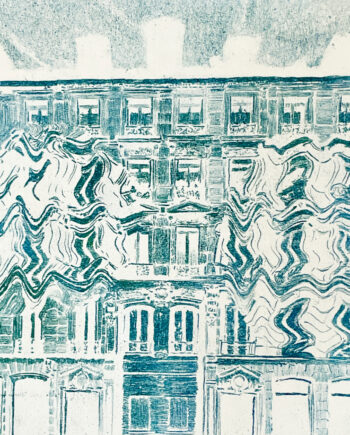 Mauro Valsecchi | Vertigini (Dizziness)

