

Herbarium: from the Latin Herbarius, from Herba: herb, is a book containing the names and descriptions and images of herbs, or plants in general, with their properties and virtues.
History of the Herbarium
In Europe, the appearance of herbals dates back at least to Ancient Greece. In ancient times,
In the history of Western culture, the study of vegetation cannot be overlooked by the binomial women-botany, which contains much strength and at the same time damnation. In Egyptian and Greco-Roman mythology, the plant world was associated with female deities. In some archaic Nordic cultures,
Despite this, privately, women continued to pass on their knowledge and were a great point of reference for many botanical scholars. In fact, the
The first written herbals were preceded by centuries in which knowledge of herbs was based on direct experience and superstition, passed down from generation to generation orally. From the 4th century BC to the 15th century AD, they were produced as unique manuscripts, used to make the oral tradition tangible and provide information on the medicinal and culinary qualities of plants, then with the invention of printing they began to be reproduced in copies.
The years between 1470 and 1670 were significant for botany, because it established itself as a scientific discipline, and these were the revolutionary centuries for the herbarium object, but it is established that the study of plants has historically also been approached from a philosophical and utilitarian point of view.
In this intertwining of thoughts, art and science meet, bringing benefits to each other. Among the first women who dealt with naturalistic painting we remember Maria Sibylla Merian who in the seventeenth century began to illustrate in an innovative way, which we can define as ecological, her studies on botany and insects, creating illustrated tables in which the subjects represented were inserted in their natural ecological context, giving a broader vision of their habitat.
Another great scientific advance was made by Carl Linnaeus in the eighteenth century when he introduced the binomial nomenclature according to which each plant has a double Latin name: the first indicates the genus to which it belongs and the second the species, bringing order to the classification of plants which is still in use today.
Illustrated Herbarium
From the point of view of the written and illustrated creation of herbals, the twentieth-century scholar of the history of botany and biology to whom these notions refer is Agnes Arber, who dedicated her life to the study of illustrated and written herbals, to trace a detailed timeline. Among the first women to be admitted to an English university, she was of great importance for the path of this history, in fact thanks to her research we can understand how the study of botany is dominated by scientific, philosophical and sensorial visions that have always guided the evolution of humanity in unison.
From an illustrative point of view, botanists hired artists to accompany their texts with illustrations of the plants they discussed. Their history, however, in the era of manuscripts is a history of degradation rather than progress, in fact initially botanical illustration was aimed at realistic and naturalistic traits, with the beginning of the spread of prints the engravings gradually degraded and simplified becoming more symbolic and approximate, sometimes even only with a decorative function rather than descriptive, generating inaccuracies with respect to the notions that were being explained.
Herbarium’s authors
In the 1st century A.D. Pedagno Discorde, was one of the most important creators of medical herbaria, characterised by naturalistic and detailed illustrations.
Among the earliest herbaria of the 15th century when movable type printing came into being is Apuleius Platonicus’ Herbarium, whose illustrations are stylised and symbolic, e.g. if a plant was used as a cure from the bite of an animal, it was depicted together with the animal.
Peter Schoffer in the 15th century created marked and decorative woodcuts with minimal attempts at realism.
In the 16th century, Jacob Meydenbach, created botanical works alongside images with vivid imagery influenced by folk and mythological tales.
Bartolomeo Anglico writes descriptions with poetic touches flanked by generic illustrations. Peter Treveris, creates stylised and symbolic engravings and texts influenced by medieval beliefs.
Otto Bunfels, also in the 16th century thanks to Hans Weiditz’s naturalistic engravings, regained the descriptive sense of the herbarium with a return to nature represented as it appears in reality.
Leonhart Fuchs continued this realistic phase by introducing the use of colour in the drawings, increasing the accuracy of the images.
Rembert Dodoens, returns slightly to stylisation while remaining in a genre of fairly naturalistic prints.
Charles de l’Ecluse, included the representation of mushrooms in his realistic prints, he can therefore be considered the founder of mycology as he portrayed and studied mushrooms for the first time.
Finally, the best known of this period include Leonardo da Vinci and Albrecht Dürer, for their precise, realistic and naturalistic engravings.
Reference text: Herbaria. Origin and evolution 1470 – 1670 , Agnes Arber, Aboca, Sansepolcro, 2019.
-
Product on sale
 Drawing Course for Children and AdultsOriginal price was: €55.00.€35.00Current price is: €35.00.
 -
Product on sale
 Painting Course for Children and AdultsOriginal price was: €55.00.€35.00Current price is: €35.00.
 -
Product on sale
 The Blue Magic of CyanotypeOriginal price was: €55.00.€35.00Current price is: €35.00.
 -
Product on sale
 Cyanotype Workshop with AperitifOriginal price was: €65.00.€45.00Current price is: €45.00.
 -
Product on sale
 Basic painting courseOriginal price was: €65.00.€45.00Current price is: €45.00.
 -
Product on sale
 Portfolio reviewOriginal price was: €120.00.€59.00Current price is: €59.00.
 -
Product on sale
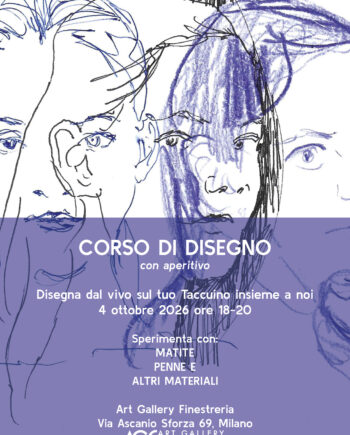 Freehand Drawing courseOriginal price was: €65.00.€45.00Current price is: €45.00.
Oil painting
The technique of oil painting began to become common and widespread in the West from the second half of the 15th century, distinguished by its qualities of resistance to the wear and tear of time, brilliance and elasticity of colour.
Thanks to the slow drying time, this technique allows the painting to be worked on unhurriedly and to create glazes that give depth to the images.
Oil colours are mixtures consisting mainly of pigments, a binder and a drying agent.
Pigments reflect light, and the finer they are, the brighter the tint will be.
To dilute the colour, the most commonly used substance is linseed oil, which has a strong drying power and offers the greatest resistance.
Each color, according to how the percentages of pigments and other substances are distributed, has a different degree of coverage, ranging from total to partial to transparent, this is important to develop the technique of glazing, starting the base with the covering colors and going to create the shades with transparent ones.
To enhance this technique it is useful to know the nineteenth century color theory of Wolfgang von Goethe that revolutionizes Newton’s theory on the refraction of light, applying it to the way we see color in everyday life.
Goethe investigates color by studying the human mind, capable of reproducing independently colors opposite to those we are observing if we look away from them and look at a neutral wall, and it discovers that each color has its own complementary that establishes a relationship of attraction and distancing compared to the first (ex. red and green, yellow and blue) this is useful for combining colors in order to create effective contrasts and shadows.
Immediately after the chemist Michel Eugène Chevreul applies these theories in an even more practical way and begins to classify the numerous existing colors thanks to the dyeers of fabrics, in graduated chromatic circles associating each color a number.
This technique is still in use today, in fact the famous Pantone bouquet calls colors by number and not by name as it happened in antiquity.
In addition, Chevreul noticed how two colors combined together influence each other creating visual effects in the mind of the observer, the dyers for example complained that the black embroidery made on colored fabrics were not completely black but greyish, this is because our mind associates the two colors and perceives them as a whole, Chevreul calls this simultaneous contrast effect.
This discovery was very important for future painters, an example are the bold shadows on the faces of Gustave Klimt’s paintings, with blue hues in contrast to red cheeks, in painting gray shadows as in reality our eye would have perceived bluish, in contrast with red, so you might as well paint them blue and enhance the contrast.
Reference text: Cromorama, Riccardo Falcinelli, Einaudi, Torino, 2017.
For more information:
Contact 00393336473615 Call us now
finestreria@gmail.com
Via Ascanio Sforza 69, Milan
-
 Giorgia Oldano
 -
 Giammarco Cugusi | Clematis Vitalba€300.00
 -
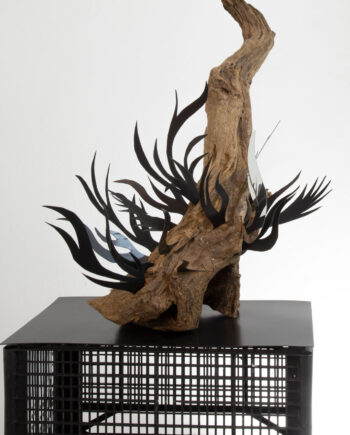 Giammarco Cugusi | I will€1,800.00

